Build financial document processing with Pulse AI and Amazon Bedrock
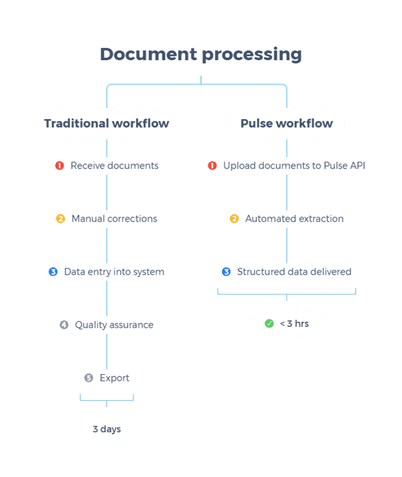
Artificial Intelligence Build financial document processing with Pulse AI and Amazon Bedrock Financial institutions process thousands of complex documents daily. Optical Character Recognition (OCR) errors in financial data can propagate through interconnected calculations, affecting analytical accuracy. While a single OCR error in a standard legal document might require only a quick manual correction, the same mistake in financial data can cascade through interconnected calculations, leading to systematic errors in analysis and potentially costly to organizations. Traditional OCR tools fall critically short when processing the complex financial documents that institutions handle daily—balance sheets, income statements, SEC filings, research reports, and audit materials. These documents feature intricate table structures with merged cells and hierarchical data, multi-column layouts with interconnected references, and context-dependent information requiring semantic understanding. Traditional OCR approaches treat these documents as images, missing the structural relationships and contextual nuances that make financial documents meaningful. The result is a cascade of manual corrections, data entry delays, and systematic analytical errors. This post demonstrates how to build a documentation extraction and model fine-tuning pipeline that addresses these critical challenges. By combining Pulse AI’s advanced document understanding capabilities with the powerful AI services of Amazon Bedrock, organizations can achieve enterprise-grade accuracy and extract contextually relevant financial insights at scale. Amazon Bedrock delivers fully managed model customization with zero machine learning (ML) ops overhead, on-demand deployment without capacity planning, and the Nova model family offers strong cost-to-performance characteristics, so teams can focus on innovation rather than infrastructure. Unlike traditional monolithic OCR pipelines,Pulse integrates vision language models with classical ML components specifically engineered for document understanding, creating an intelligent solution that extracts structured data with semantic awareness, generates improved supervised fine-tuning datasets for financial domain models, and enables deployment of custom large language models (LLMs) trained on your specific financial data. Pulse is deployed across global enterprises including Samsung, Cloudera, Howard Hughes, and Fortune 500 financial institutions and leading private equity firms processing high volumes of financial and operational documents. In one deployment, a batch of about 1,000 complex financial documents that previously required multi day turnaround was processed in under three hours, producing structured, auditable outputs ready for downstream analytics and AI applications. In summary, Pulse AI and Amazon Bedrock together provides: - Pulse AI extracts structured, semantically-aware data from complex financial documents handling intricate tables, multi-column layouts, and hierarchical data. - Amazon Bedrock fine-tunes Amazon Nova models on that high-quality data to create domain-specific intelligence for your organization’s financial conventions. - Custom models then process new documents with organization-specific understanding, reducing manual review from days to hours. The following workflow demonstrates an approach to building intelligent financial applications powered. Starting with raw financial documents, the pipeline orchestrates a sophisticated series of steps—from document processing and fine-tuning, and deployment—to create a custom AI solution tailored to financial data analysis and insights. The system begins by (step 1) ingesting the documents into the Pulse container in your VPC or Pulse software as a service (SAAS) offering. The Pulse model processes the financial documents (step 2).…